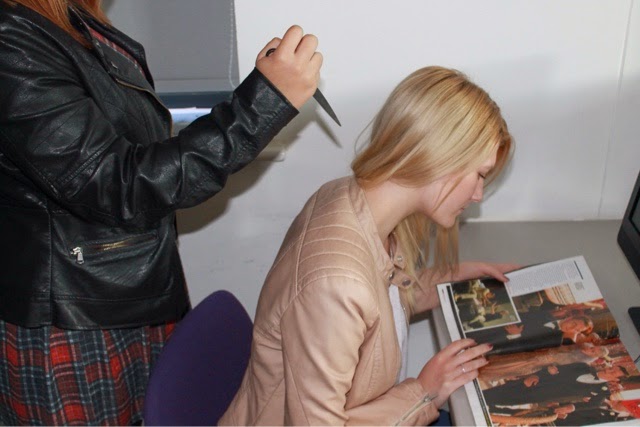
This task consisted of experimenting different camera angles and techniques. We did this so we could understand how to use different camera angles and decide on how to incorporate these into our short film to create a specific atmostphere.
Wednesday, 26 November 2014
Camera Angles
This task consisted of experimenting different camera angles and techniques. We did this so we could understand how to use different camera angles and decide on how to incorporate these into our short film to create a specific atmostphere.

Friday, 24 October 2014
The Ousider Radio Trailer

As a group we had to create a radio trailer for our images narratives which were about the outsider. We decided to start with a phone call to indicate that whoever was calling were no longer able to talk to them in person as the dialogue within states. Following the phone call we introduced a piano track which you are able to see below to create a sense of mystery when the music intensifies it suggests that it has gotten worse as behind the piano track there is sound effects to create the illusion that things aren't all as they seem which is shown by the explosions and the sound of someone running. This is all cut off by a gun shot in which explains that the genre is in fact a action thriller. We then inserted another answer machine to show that the woman who was calling at the beginning has no idea of what is happening. Below is a screen shot of garage band to how we made the trailer.
Wednesday, 15 October 2014
Audience Questionnaire on Film
The questionnaire below is to find out more about the audience who are interested in film. They can be very useful to figure out the what they enjoy about certain things in film and what attracts them to watch the films they do.
Uses and Gratifications Theory
“Uses and gratifications theory is a popular approach to understanding mass communication. The theory places more focus on the consumer, or audience, instead of the actual message itself by asking “what people do with media” rather than “what media does to people” (Katz, 1959) It assumes that members of the audience are not passive but take an active role in interpreting and integrating media into their own lives. The theory also holds that audiences are responsible for choosing media to meet their needs. The approach suggests that people use the media to fulfil specific gratifications. This theory would then imply that the media compete against other information sources for viewers’ gratification. (Katz, E., Bulmer, J. G., & Gurevitch, M. 1974)”
Uses and Gratifications needs to fulfil one of the following:
- Identify - the audience is able to recognise with a product or person
- Educate - the ability to receive the information, knowledge of their pleasing
- Entertain - The audience must be able to receive enjoyment and some form of "escapism"
- Social Interaction - Media products are able to start a conversation/ forum between the consumers of their products.
Over the past 10 years the internet has played part in how uses and gratifications theory is perceived:
- The internet allows us to become aware of more products and people due to the search engines where we are able to search for our needs and they also bring up similar sites which expands our need for these.
- Factual websites allow the audience to learn whatever they may wish, thanks to websites like Wikipedia, e-lawresorces etc. it is argued that the internet has developed education massively in the past 10 years.
- Music especially has benefited a great amount from this as YouTube, Spotify and iTunes etc. allows the audience to watch or listen to any thing they like which gives the audience opportunities to be entertained whenever they please.
- Internet also allows freedom as you have social networking sites from which you are able to communicate with people from around the world and also sites which can enable us to escape all worries and stress with just a click of a button.
Reception Theory
This theory states that in any text produced for an audience has a hidden message behind the words and when they have the correct audience some are able to recognise the meaning behind the words whereas others will not be able to understand the meaning. It is also down to what the audience interpret the text as some will interpret it on the same level as the write whereas some won't it all depends on how well they know the writers analytical work. Under reception theory Stuart Hall created another theory which states that there is 3 different reading types;
- Dominant Reading - The audience are able to decode the message and completely agrees with the ideas presented.
- Oppositional Reading - The audience disagrees with the message and rejects the idea.
- Negotiated Reading - The audience partially agrees with the message and is kind of in between.
Hypodermic Syringe Theory
The media injects the message into audience mind and it cause changes in audience behaviour and psyche towards the message. Audience are passive and they can’t resist the media message.
Two- Step Flow Theory
This theory has two steps hence the name which are;
- Step One - the opinion leaders get the information from a media source
- Step Two - they then pass on the information, along with their thoughts on it, which is then influenced to their families, friends and acquaintances.
From this the opinions are heavily influenced by that of what the opinion leaders have said so say if someone really likes the harry potter series and they then tell a friend to also watch the film they will most likely have a good opinion on the series as what the leader has said has influenced this.
Friday, 10 October 2014
Theories
Levi-Strauss
A French ethnologist and anthropologist whose work is
important in various fields such as humanities, sociology and philosophy.
In this way, he identified Binary
Oppositions that help to identify underlying themes and symbolic meanings. He is also responsible for the theory of the
five stages of narrative which are:
Development
Complication
Climax
Resolution.
Erving Goffman
A very influential Canadian sociologist whose theories on four different Character Types are used repeatedly by film critics and theorists alike. The four character types are:
The protagonist – lead character
The deuterogamist – secondary lead character
The bit player – minor character with unknown background
The fool – a character who uses humour to convey messages
Syd Field
A recently-deceased ‘American screen writing guru’ whose focus is entirely on transferring the art of story-telling into the medium of film. He is responsible for the three-act structure which are:
A recently-deceased ‘American screen writing guru’ whose focus is entirely on transferring the art of story-telling into the medium of film. He is responsible for the three-act structure which are:
1st act – set up
2nd act – confrontation
3rd act – resolution
MacGuffin
 Alfred Hitchcock was a very successful film director and producer and was often nicknamed "The Master of Suspence", he pioneered many techniques in the suspence and psychological thriller genres. He created the term MacGuffin which means a plot. Device with little or no narrative explanation. This is to attract he audience in the first a act to allow them to become suspicious of things going on. It is commonly used in thrillers as his can be done quite easily to keep the audiences attention. It has been achived in many films from North by Northwest, Star Wars, the 39 steps and many more. The Princeton WordNet simply states it as "a plot element that catches the viewers' attention or drives the plot of a work of fiction"
Wednesday, 24 September 2014
Barthes Five Codes
Roland Barthes was a French literary theorist who explored a diverse range of fields and influenced the development of schools.
The five codes are;
- The Hermeneutic/ Enigma Code (HER) The purpose of his is to keep the audience guessing until the final scenes when all is revealed and closure is achieved.
- The Proairetic/ Action Code (ACT) Also builds tension, referring to any other action or event that indicates something else is going to happen. the hermeneutic and proairetic codes work together to develop the stories tensions and keeps the reader interested.
- The Semantic Code (SEM)
This code refers to the connotation within the story that gives additional meaning over the basic denotative meaning of the word. It is by the use of extended meaning that can be applied to words that authors can paint rich pictures with relatively limited text and the way they do this is a common indication of their writing skills
- The Symbolic Code (SYM)
This is very similar to the sematic code but acts at a wider level, organising semantic meaning into broader and deeper sets of meaning. This is typically done in the use of antithesis, where new meaning arises out of opposing and conflict ideas
- The Referential/ Cultural Code (REF)
This code refers to anything that is founded on some kind of canonical works that cannot be challenged and is assumed to be a foundation for truth. Typically this involves either science or religion, although other canons such as magical truths may be used in fantasy stories. The gnomic code is a cultural code that particularly refers to sayings, proverbs, clichés, and other common meaning giving words sets.
Saving Private Ryan
The Hermeneutic/ Enigma Code (HER)
Where are they going?Who are they?
What do the flags signify?
Was he an ex solider?
Is he related to the deceased?
What's happening?
The Proairetic/ Action Code (ACT)
drums added to non diegetic music
close up of his eyes
music intensifies as he walks up to the grave
The Semantic Code (SEM)
change to higher diegetic soundslows down the pace of the music
The Symbolic Code (SYM)
flags
cemetery
music - violins, drums, trumpets
The Referential/ Cultural Code (REF)
both flags
Using Barthes Codes
Using Barthes narrative codes, in a group, we applied these to a film and also our own story based on the outsider. We chose the rom com genre as this I think would be the most different as the outsider includes gangs and ambushes in which we were able to apply to ours in a unique way.
Fistful Of Dollars
Hermeneutic codes- Which is the good team?
Who's going to die?
Who's going to shoot first?
Proairetic codes - Music intensifies
Reaches for their guns
Semantic codes - Laughing
Symbolic codes - Clothing
Scenery
Referential codes - Gun fight
Our Rom Com
Hermeneutic codes - How far will they go to win the guy?
What does he think of it all?
Proairetic codes- Setting traps for each other
Revenge
Semantic codes - Laughing
Overheard Conversations
Symbolic codes - The guy
The two opposite girl clichés
Referential codes - Girly fights
Dumb blonde characters
Monday, 22 September 2014
Image Narratives
As a group we were given a task to create a story board to represent a crime scene. Our crime scene creates a Sence of unknown as you can't see either faces and you don't know what has happened before as such. We used the thought of post-it notes as a warning to create suspence within our images, another factor for suspence is the face that you again can't see their faces. These images are shown below.




Subscribe to:
Posts (Atom)