Pages

Wednesday, 24 September 2014

Barthes Five Codes

Roland Barthes was a French literary theorist who explored a diverse range of fields and influenced the development of schools.

The five codes are;
  • The Hermeneutic/ Enigma Code (HER)
  • The purpose of his is to keep the audience guessing until the final scenes when all is revealed and closure is achieved.
  • The  Proairetic/ Action Code (ACT)
  • Also builds tension, referring to any other action or event that indicates something else is going to happen. the hermeneutic and proairetic codes work together to develop the stories tensions and keeps the reader interested.

  • The Semantic Code (SEM)
  • This code refers to the connotation within the story that gives additional meaning over the basic denotative meaning of the word. It is by the use of extended meaning that can be applied to words that authors can paint rich pictures with relatively limited text and the way they do this is a common indication of their writing skills

  • The Symbolic Code (SYM)
  • This is very similar to the sematic code but acts at a wider level, organising semantic meaning into broader and deeper sets of meaning. This is typically done in the use of antithesis, where new meaning arises out of opposing and conflict ideas

  • The Referential/ Cultural Code (REF)
  • This code refers to anything that is founded on some kind of canonical works that cannot be challenged and is assumed to be a foundation for truth. Typically this involves either science or religion, although other canons such as magical truths may be used in fantasy stories. The gnomic code is a cultural code  that particularly refers to sayings, proverbs, clichés, and other common meaning giving words sets.
    Saving Private Ryan

  • The Hermeneutic/ Enigma Code  (HER)
  • Where are they going?Who are they?

    What do the flags signify?
    Was he an ex solider?
    Is he related to the deceased?
    What's happening?

  • The Proairetic/ Action Code (ACT)
  • drums added to non diegetic music

    close up of his eyes  music intensifies as he walks up to the grave

  • The Semantic Code (SEM)
  • change to higher diegetic soundslows down the pace of the music

  • The Symbolic Code (SYM)
  • flags cemetery music - violins, drums, trumpets

  • The Referential/ Cultural Code (REF)
  • both flags 


    Using Barthes Codes


    Using Barthes narrative codes, in a group, we applied these to a film and also our own story based on the outsider. We chose the rom com genre as this I think would be the most different as the outsider includes gangs and ambushes in which we were able to apply to ours in a unique way.

    Fistful Of Dollars 
    Hermeneutic codes- Which is the good team?
                                     Who's going to die?
                                     Who's going to shoot first?

    Proairetic codes - Music intensifies 
                                Reaches for their guns 

    Semantic codes - Laughing 

    Symbolic codes - Clothing 
                                Scenery

    Referential codes - Gun fight


    Our Rom Com

    Hermeneutic codes - How far will they go to win the guy?
                                      What does he think of it all?

    Proairetic codes- Setting traps for each other 
                                Revenge 

    Semantic codes - Laughing
                                Overheard Conversations 

    Symbolic codes - The guy 
                                The two opposite girl clichés 

    Referential codes - Girly fights 
                                  Dumb blonde characters 

    Monday, 22 September 2014

    Image Narratives


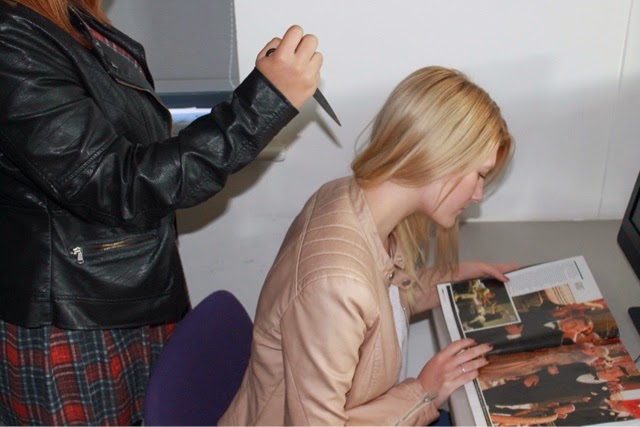
    As a group we were given a task to create a story board to represent a crime scene. Our crime scene creates a Sence of unknown as you can't see either faces and you don't know what has happened before as such. We used the thought of post-it notes as a warning to create suspence within our images, another factor for suspence is the face that you again can't see their faces. These images are shown below.


    Friday, 19 September 2014

    60 Second Bunny Task

    Propps Theory - Character Theory
    Vladimir Propp developed a character theory, which indicates that there were 7 broad characters. The 7 characters are:

    1. The villain

    2. The donor

    3. The helper

    4. The princess

    5. The false hero

    6. The dispatcher

    7. The hero
    Todrovs Theory - Narrative Theory
    Tzvetan Todorov developed a narrative theory which states that there is a pattern in the narratives of films and there are 5 steps in this pattern.

    1. The Equilibrium

    2. A Disruption

    3. Realisation

    4. Restored Order

    5. A New Equilibrium

    Below are slideshares I found whilst researching both theorists they give a brief description of what both theories are. Vladimir Propp analysed the basic plot components of Russian folk tales to identify their simplest narrative elements. Tzvetan Todorov is a  historian and essayist and is the author of books and essays about literary theory, thought history and culture theory.


    These theories are easily applied to almost any film/story. The clip below takes a film and uses the theories in order to easily show the storyline in 30 seconds. You can see clearly how these theories have been applied, especially Propps theory as the characters are very distinctive and relatively easy to spot. Todorovs theory is slightly more difficult to spot in a film as some change the order of this.


    Monday, 8 September 2014

    Shadow Task

    For this task we were put into groups to produce an image each of shadows creating a meaning of meeting. In our group we ended with a range of different images including the one below and the reason behind this is meeting someone you know only to be held at gun point. To create this image we used a flash light, digital camera and a dark room as this produced just the right light and contrast we needed. 


    Wednesday, 9 July 2014

    Short Films With A Meaning

    I have chosen to link these short films as I noticed that the ones that I had watched, on youtube, had conventions of putting a meaning behind the film and it is very noticeable throughout. The meanings conveyed are relatable to everyday life as it is the small things that these films pick out on whether that is identity, disability or just a personal thing.

    Wednesday, 2 July 2014

    Task 5: The Fault In Our Stars Reviews


    On rotten tomatoes the reviews for The Fault In Our Stars is 80% positive: 20% negative. I have included some of the reviews that I think are based on the narrative, genre, stars and directors. A common thing nearly all reviews commented about was how they portrayed Hazel, with her having cancer some critics think that they have shown her wrongly and also a few critics said that "It’s not that The Fault in Our Stars does anything particularly grievous, it just does too much of what it has." Personally I loved the film and I also understand where the negative reviews are coming from as this can be an upsetting or an annoying film to those who have seen someone close suffer so badly from it.

    Monday, 23 June 2014

    Task 4: Film Story board

    1.    A character is outside in an uninhabited area.
    Tracking her feet, as she is walking down towards the woods.

    2.    She cannot decide which way to go. Something makes him/her head towards a settlement.
    Over the shoulder shot, showing the settlement in front of her, split screen of the two paths and the contrast between them. This is followed by an extreme close up of her eyes looking left and right, showing her indecisiveness on which way to go.

    3.    She walks towards the settlement and then comes to a folk in the path- one path is safer but will take a long period of time, yet the other path is much more dangerous but is quicker. She chooses the dangerous path.
    She hears the sound of a squawking crow and the whistling of the wind (diegetic sound).

    4.       She heads towards the woods, as she walks through; it becomes darker and more secluded, she then hears noises and becomes frightened.
    High angle shot showing her vulnerability, point of view shot watching the girl to show she is not alone in the woods.

    5.    She decides to turn back but the trees have blocked her path. She quickens her pace to get out of the woods but the trees are attacking her, trying to avoid her from escaping, the noises are getting louder, she struggles to get out. She then trips over a branch and hits her head.
    Point of view shot turning to see what is behind her, followed by a reaction shot of the girl, sound of the branches cracking, the wind and the crows get louder, which emphasise her panic and level of danger. She hears the sound of a gunshot and it is a panning shot showing her turning around, the camera moves as a point of view shot of her running through the woods, the camera then turns to show her feet and the sound of her falling over a branch.

    6.    She then awakens to see the change in setting, it is sunny and the woods have disappeared, she looks up to the sky to see a silhouette of a man riding towards her on a stallion, he helps her up from the ground.
    High angle of her opening her eyes and reaction shot to the change in setting, romantic music- violin (non- diegetic sound) as the man moves towards her. Point of view shot from her as he helps her up.

    7.    He expresses his eternal love for her, and his mission to save her from the woods; he bends down on one knee. She automatically expects a proposal and begins to express her mutual excitement and love for him. However as he reaches in his pocket, he pulls out a gun and aims at her head.
    The music continues and then ends abruptly as the gun is pulled from his pocket, tracking of his hand as he reaches for the gun, as he takes off the safety lock.

    8.    She screams and he fires the gun, the screen goes black. The scene then commences with her stood in the same position and a figure behind her then falls to the ground (slow motion). 
    Sound of the gunshot coincides with the screen turning black, followed by the sound of buzzing (ringing in ears), fade back into the image of side view of the man falling to the ground; she is in the foreground of the shot.

    9.    She questions her lover, yet he tells her that he has no time to explain, he grabs her hand and they run away. At this point, men are jumping from trees, out of the grass and beside them on horses and firing at the couple. After battling a few of the men, he then is shot in the heart.
    Fast paced music to match the action taking place, jump cuts to the different men targeting the couple, extreme close up of bullet leaving the gun of one of the attackers to reaching the heart of the man (slow motion.

    10.  He falls to the ground, she tries to help him but his wounds are too severe to save him. The men surround her, the scene turns black. A green beam then appears from the sky, and a space ship appears.
    The sound of the men moving towards them increases in volume representing them closing in on them, extreme close up of her crying, reaction shot, the screen fades to black but the sound of the men moving towards her continue. Low angle shot looking up at the space ship, she is still captured in the shot looking up at the beam (still her point of view).  Standard sound of space ship.

    11.  The other men leave the scene in fear, the girl tries to hurry away but gets zapped up by the space ship, the space ship then flies away, the man is left alone to slowly die a painful death, his dying, last words- “ this isn’t how it was supposed to happen”.
    Space ship sound gets louder as well as the sound of the men hurrying away, sound of the girl struggling to escape, her running towards the camera as it tracks backwards, and she is taken by the spaceship. Close up of the man saying his final words, sound of slow violin to emphasise sorrow.